


Manual invoicing can drain precious hours from even the most efficient Managed Service Provider teams. For IT managers and billing coordinators, adopting billing automation means moving beyond error-prone spreadsheets toward a new standard of accuracy and speed. Billing automation delivers rapid electronic invoicing, global accessibility, and a better payment experience for both providers and clients, setting the stage for smoother financial operations and long-term client satisfaction.
Table of Contents
- Defining Billing Automation In Managed Services
- Core Processes And Integration Methods
- Types Of Billing Automation Solutions
- Key Benefits For Msp And Their Clients
- Pitfalls, Risks, And Financial Implications
Key Takeaways
| Point | Details |
|---|---|
| Billing Automation Enhances Efficiency | Automating billing processes allows MSPs to eliminate manual tasks, reduce errors, and accelerate payment cycles. |
| Integration is Crucial for Success | Effective billing automation relies on connecting various software systems to streamline data flow and reduce manual entry. |
| Diverse Solutions Cater to Different Needs | MSPs can choose from cloud-based, enterprise-level, or specialized solutions, depending on their specific operational requirements. |
| Risks Must Be Managed | Implementing billing automation involves financial risks that require thorough testing, strong security measures, and continuous monitoring. |
Defining Billing Automation in Managed Services
Billing automation represents a strategic technological transformation for Managed Service Providers (MSPs), enabling them to streamline financial operations and enhance overall business efficiency. At its core, billing automation leverages electronic systems to automatically generate invoices, track payments, and manage customer financial data with unprecedented accuracy and speed. This approach goes far beyond traditional manual invoicing methods, transforming financial processes for modern managed services.
The fundamental goal of billing automation is to eliminate repetitive manual tasks that consume valuable time and resources. By integrating advanced digital technologies, MSPs can create standardized invoicing workflows that reduce human error, accelerate payment cycles, and provide real-time financial insights. These systems typically support multiple payment options including credit cards, electronic transfers, and digital wallets, giving customers flexible transaction methods while ensuring consistent revenue tracking for service providers.
Modern billing automation solutions are designed with scalability and global accessibility in mind. Cloud-based platforms enable MSPs to manage invoicing processes across different geographic regions, supporting multi-currency transactions and complex contractual arrangements. By leveraging technology-enabled processes that extend beyond simple transactional tasks, these systems help managed services maintain predictable cost structures and deliver consistent financial experiences for their clients.
Pro tip: Implement a billing automation system that offers robust reporting features, allowing you to track key financial metrics in real-time and identify potential revenue optimization opportunities.
Core Processes and Integration Methods
Billing automation encompasses a comprehensive set of interconnected processes designed to transform financial management for Managed Service Providers (MSPs). The core integration methods typically involve several critical technological components that work together to create a seamless invoicing and payment ecosystem. These include automated data capture, invoice generation systems, payment processing platforms, and advanced reconciliation technologies that enable real-time financial tracking.
The primary integration methods for billing automation revolve around connecting multiple software systems and data sources. MSPs often utilize enterprise resource planning (ERP) integration techniques that link billing platforms with customer relationship management (CRM) systems, accounting software, and service delivery platforms. This holistic approach ensures that billing information flows automatically across different organizational systems, reducing manual data entry and minimizing potential errors. Key integration points include synchronizing service delivery records, tracking billable hours, generating precise invoices, and managing recurring billing cycles for ongoing managed services.
Technical integration typically involves several sophisticated mechanisms. Application Programming Interfaces (APIs) serve as the primary bridge between different software systems, allowing seamless data exchange and real-time updates. Webhooks enable instant communication between billing platforms and external systems, triggering automatic notifications and updates. Cloud-based integration platforms further enhance flexibility, allowing MSPs to connect disparate systems regardless of their original software architecture. These integration methods support multiple billing models, including fixed-rate contracts, usage-based billing, and hybrid pricing structures that accommodate complex service delivery requirements.
Pro tip: Select a billing automation platform that offers robust API capabilities and supports multiple integration protocols to ensure maximum flexibility and scalability for your managed services ecosystem.
Types of Billing Automation Solutions
Billing automation solutions for Managed Service Providers (MSPs) have evolved into sophisticated platforms that address diverse financial management needs. These solutions can be broadly categorized into three primary types: cloud-based billing systems, integrated enterprise solutions, and specialized MSP billing platforms. Each category offers unique features designed to streamline financial processes and enhance operational efficiency.
Cloud-based billing systems represent the most flexible and scalable solution for modern MSPs. These platforms provide real-time invoicing capabilities, support multiple billing models, and enable flexible pricing configurations across different service tiers. They typically feature automated recurring billing, prorated charge calculations, and seamless integration with existing accounting and customer management systems. Key advantages include reduced infrastructure costs, automatic updates, and the ability to access billing information from anywhere with internet connectivity.

Enterprise-level billing automation solutions offer more comprehensive financial management capabilities. These advanced platforms go beyond basic invoicing by incorporating complex revenue recognition rules, multi-currency support, and detailed financial reporting. They are particularly suited for larger MSPs with complex service portfolios and international client bases. Such solutions often include advanced features like predictive billing analytics, contract management tools, and sophisticated reconciliation mechanisms that can handle intricate billing scenarios across multiple service lines and client agreements.
Pro tip: Evaluate billing automation solutions based on their scalability, integration capabilities, and ability to handle your specific service delivery models rather than focusing solely on price.
Here is a comparison of billing automation solution types and their business impacts:
| Solution Type | Core Features | Best Fit For | Typical Business Impact |
|---|---|---|---|
| Cloud-Based | Real-time access, recurring billing | Small to mid-sized MSPs | Low infrastructure cost, flexible scaling |
| Enterprise-Level | Complex analytics, multi-currency | Large or global MSPs | Improved compliance, advanced reporting |
| Specialized MSP | MSP-focused integrations, support | Niche service providers | Streamlined MSP workflows, tailored tools |
Key Benefits for MSPs and Their Clients
Billing automation delivers transformative advantages that fundamentally reshape financial operations for Managed Service Providers (MSPs) and their clients. By eliminating manual processes, these solutions create significant efficiencies that translate directly into improved operational performance, reduced administrative overhead, and enhanced financial transparency. The benefits extend far beyond simple cost savings, touching nearly every aspect of service delivery and client relationship management.
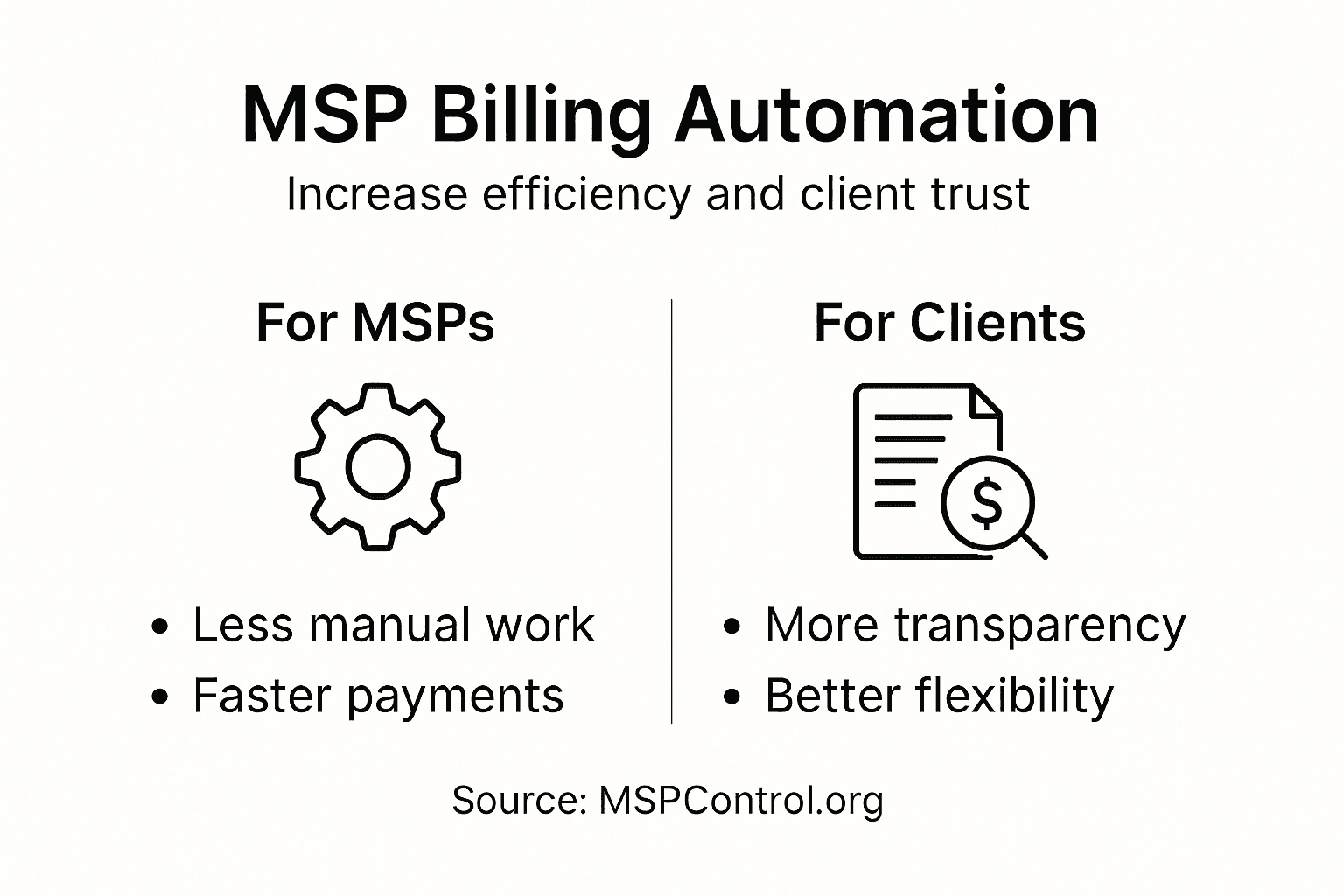
For MSPs, billing automation provides critical operational improvements. Streamlined asset management tools enable more accurate tracking of billable services, reduce revenue leakage, and provide granular insights into service profitability. Automated systems dramatically reduce administrative workload, allowing technical teams to focus on high-value strategic activities instead of repetitive invoicing tasks. These platforms generate detailed financial reports, support complex pricing models, and enable real-time revenue tracking that helps MSPs make more informed business decisions.
Clients benefit equally from billing automation through increased transparency, predictability, and flexibility in their service consumption. Automated billing systems provide detailed, itemized invoices that break down exactly what services were used, when, and at what cost. This level of granularity helps clients understand their technology spending, allocate budgets more effectively, and validate the value they receive from their managed services provider. Additionally, these systems support multiple payment methods, offer self-service portals for invoice review, and enable flexible billing cycles that can be customized to match individual client preferences and cash flow requirements.
Pro tip: Implement a billing automation solution that offers comprehensive reporting and transparent pricing to build trust and demonstrate clear value to your clients.
Pitfalls, Risks, and Financial Implications
Billing automation, while transformative, presents a complex landscape of potential risks and financial challenges that MSPs must carefully navigate. The implementation of these systems requires strategic planning and comprehensive risk mitigation to prevent unintended financial consequences. Technological complexity, data security, and integration challenges represent the primary areas of potential vulnerability for organizations seeking to modernize their billing processes.
The most significant financial risks emerge from inadequate system design and poor implementation strategies. Azure cloud management features highlight the importance of robust security protocols and precise configuration. Potential pitfalls include incorrect billing calculations, data synchronization errors, and compliance violations that could result in substantial financial penalties. MSPs must invest significant time in thorough testing, validation of pricing algorithms, and continuous monitoring to prevent revenue leakage, billing inaccuracies, and potential legal disputes arising from computational errors or inconsistent charge structures.
Cybersecurity represents another critical risk dimension in billing automation. Automated systems create multiple potential entry points for malicious actors, making comprehensive security infrastructure essential. Financial data transmission requires end-to-end encryption, multi-factor authentication, and rigorous access control mechanisms. MSPs must implement sophisticated security layers that protect sensitive client billing information while maintaining system flexibility and user accessibility. The financial implications of a potential data breach can be catastrophic, potentially resulting in substantial regulatory fines, client trust erosion, and long-term reputational damage.
Pro tip: Conduct thorough security and accuracy audits of your billing automation system quarterly, focusing on identifying potential vulnerabilities and verifying computational precision.
Below is a summary of major risks in billing automation and strategies to mitigate them:
| Risk Area | Common Issues | Mitigation Strategy |
|---|---|---|
| Technology Complexity | Configuration errors, system bugs | Thorough testing, phased rollouts |
| Data Security | Unauthorized access, data leakage | Multi-factor authentication, encryption |
| Integration Challenges | Incompatible platforms, sync errors | Use APIs, regular data audits |
Transform Your MSP Billing with Automated Efficiency
Billing automation offers the key to resolving the costly challenges MSPs face like manual errors, delayed invoicing, and complex multi-system integrations. With the growing demand for scalable, secure, and transparent billing processes emphasized in the article, MSPs now need a single unified solution that simplifies recurring charges, supports multiple billing models, and enhances real-time financial insights without the technical headaches.
MSPControl.org is built specifically for providers eager to automate customer billing alongside other critical IT management tasks. Our platform integrates powerful automation tools for cloud services, invoice generation, and payment processing within one seamless environment. This approach eliminates revenue leakage and administrative overload while improving client transparency through detailed, itemized billing reports.
Explore how you can boost your operational efficiency with MSPControl’s comprehensive suite designed for MSPs. Take control of billing automation, security compliance, and service delivery in one place.
Ready to reduce manual billing errors and accelerate your revenue cycle? Visit MSPControl.org today to discover the full potential of automated billing and unlock smarter service management for your business. Start your journey toward streamlined client billing and scalable growth now with MSPControl and experience the difference a truly integrated platform can make.
Frequently Asked Questions
What is billing automation in managed services?
Billing automation in managed services refers to the use of electronic systems to automate financial operations. This includes generating invoices, tracking payments, and managing financial data, which enhances accuracy and efficiency compared to traditional manual methods.
How does billing automation improve efficiency for Managed Service Providers (MSPs)?
Billing automation streamlines billing processes by reducing manual tasks, minimizing human error, and accelerating payment cycles. It enables MSPs to focus on strategic activities, ultimately improving operational performance and reducing administrative overhead.
What types of billing automation solutions are available for MSPs?
There are three primary types of billing automation solutions for MSPs: cloud-based billing systems, integrated enterprise solutions, and specialized MSP billing platforms. Each type offers different features for managing financial processes, catering to various business sizes and needs.
What are the key benefits of implementing billing automation for clients?
Clients benefit from increased transparency, predictability, and flexibility in billing. Automated systems generate detailed invoices, support multiple payment methods, and offer self-service options for reviewing bills, which enhances the overall client experience.